Start with Meshy for attribution-compatible free output. Evaluate Rodin’s Creator plan for a private reference-led workflow: base pricing is $30/month or $288/year. Neither has a measured output-quality win here.
| Decision | Meshy | Hyper3D Rodin |
|---|---|---|
| Reason to shortlist | Documented free-output attribution terms for an initial experiment. | Optional multi-view input for a brief with several reference views. |
| Commercial rights | Free outputs use CC BY 4.0; paid privacy and ownership terms differ. | Creator lists unlimited exports, private assets and “any use”; input rights and provider terms still apply. |
| Reference fidelity | Inspect hidden surfaces; an image is not a measured model. | Multiple views are an input option, not evidence of dimensional accuracy. |
| Before paying | Confirm the selected mode allows the required download. | Base Creator: $30/month or $288/year. Check volume tier and per-task credit spend. |


Documented conditions: Meshy official terms ↗ Hyper3D Rodin official terms ↗ Hyper3D Rodin official terms ↗ Feature access does not establish output quality.
Meshy vs Rodin: what can this comparison establish?
Meshy has published free-output attribution terms. Rodin documents optional multi-view references and common mesh exports. Those are reasons to investigate a workflow, not evidence that either service generates better geometry.
This is a documentation-based comparison, without matched generations. Rodin’s published base subscription prices and export conditions were checked on October 21, 2026. Exact credit spend for a particular mode and the quality of its exported result still need a real task; we do not declare a cost-per-usable-asset winner.
One reference image or several views?
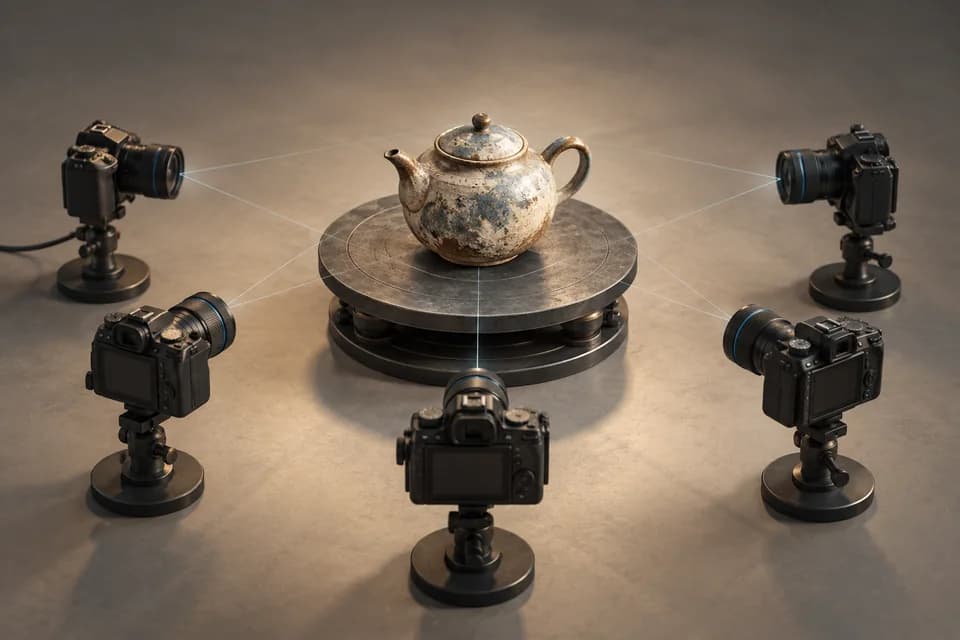
Hyper3D’s official site describes generation from a single image without a prescribed pose; additional views are optional. Several views can communicate a rear handle or side panel that is missing from the front image. They do not establish the accuracy of the output.
Meshy also documents image-led and multi-view workflows. The relevant question is which mode your plan permits and how consistently the references describe one object. A handle visible in one photo but absent in another creates conflicting input for either service.
For a record of an existing object, consider multiple-photo reconstruction. For a replacement part that must fit hardware, use measured CAD. Neither an attractive render nor multiple input views establish engineering tolerances.
Rodin’s published plan conditions
Meshy’s pricing page lists free assets under CC BY 4.0, with attribution required, and paid assets as private and customer-owned. Input rights and available downloads still matter. Its review explains when privacy changes the decision.
The Hyper3D pricing page shows these base tiers, checked in both billing modes on October 21, 2026. Higher volume settings change the price.
| Plan | Monthly billing | Annual billing | Published conditions |
|---|---|---|---|
| Free | $0 subscription | No annual commitment shown | Preview before credit confirmation; legacy-model exports; 10 private assets |
| Creator, base volume | $30/month | $288/year ($24/month equivalent) | Multi-image input, unlimited exports and private assets; “any use” listed |
| Business, base volume | $120/month | $1,152/year ($96/month equivalent) | Creator benefits plus full API access and higher redo limits |
Prices are shown with the official page’s dollar symbol; this is not a localized tax or checkout quote. Free access is not a promise of unlimited free downloads: the page describes pay-by-result confirmation and direct credits at $1.50 per credit. Its estimated model counts are vendor estimates, not our measured output. Unlimited exports also do not establish unlimited generation. The named paid-plan usage benefits remain subject to Hyper3D’s terms and the rights to your inputs.
Compare the billable event before comparing a model count
Meshy Free’s checked allowance is 100 monthly credits and 10 downloads of Meshy 6 Lite models. Rodin’s free workflow asks you to preview a result before confirming credit spend, with export access governed by its current plan and model conditions. A Meshy generation allowance and a Rodin confirmed result are therefore not equivalent units of finished work.
Use this calculation for a pilot: total task credits spent on all attempts divided by the number of accepted exports. If none passes your required handle or seam check, report zero accepted assets; there is no meaningful finite credit cost per accepted asset yet. Keep subscription charges and manual editing minutes in separate columns. This is a calculation method, not a measured price comparison.
Which file do you actually need?
Rodin lists STL, FBX, OBJ, GLB, GLTF and USDZ on its official homepage. A supported-format list does not mean every generation mode or free tier includes every download. Meshy also documents common mesh and scene delivery; verify the selected mode rather than assuming entitlement from the format name.
For a web asset, inspect the GLB materials in the receiving viewer. For printing, turn off textures and measure the exported STL. The format guide explains why a textured scene loses information when reduced to STL geometry.
A controlled trial brief: the handle on the back
A product housing with a rear handle makes a useful evaluation object. Use original reference images that show the same housing from the front, side and back. Identify the handle opening and a visible seam before generating.
For each service, record the plan and generation mode, the same input set where supported, every attempt, the downloaded file and the edits required. Inspect whether the handle is open geometry or a painted mark. This is a proposed trial, not a test we have completed.
If one service cannot accept the same inputs under the available plan, record that constraint instead of calling it a quality failure. If separate-part editing is the main requirement, include Tripo through the AI generator shortlist.
Can gallery images settle the choice?
No. Galleries do not establish your asset’s license, export entitlement, hidden geometry or correction workload. Meshy has a documented route for attribution-compatible free output; Rodin’s paid tiers provide a documented route to private assets and broader exports, with the base costs listed above. Neither has a measured quality win in this review.
Research method & official sources
Initial source review . This page uses official documentation; later source checks and any executed file examples are dated and scoped in the text. We have not benchmarked AI generation quality or performed physical print tests.
- Hyper3D pricing and paid-plan conditions ↗
- Meshy plans and output rights ↗
- Meshy features ↗
- Hyper3D Rodin ↗
Read our editorial and affiliate standards. Product recommendations do not depend on an affiliate relationship.